Buzzkill: What’s Really Threatening Our Bees
The backbone of global pollination, bees do the heavy lifting in the global food system. Instead of making their jobs harder, everyone can pitch in with some basic actions to restore bee populations.
Episode 42
11/20/2025
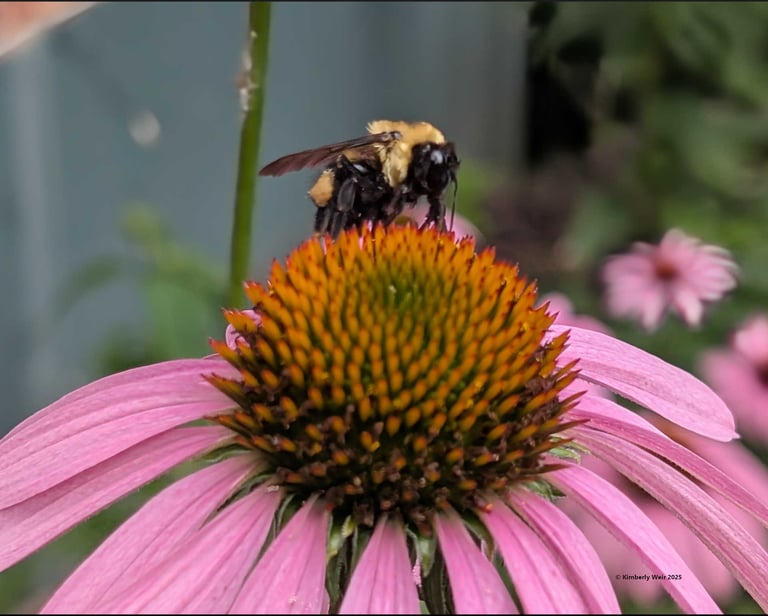
Following the last episode’s general focus on pollinators, this episode zooms in on bees. From the ethics of beekeeping, why seedless watermelons make bees work overtime, and the unsettling nature of colony collapse disorder, Jorden and Kimberly consider the astonishing diversity of bees. In addition to the legislative acts that promote apiary conservation, individuals can do a lot that matters, including rewilding yards, reducing pesticides, leaving fallen wood, planting natives, supporting local honey, and even “adopting” a bee.
Recommended Resources
Transcript
Kimberly
Welcome to this episode of Sustainable Planet. I'm political scientist Kimberly Weir and my co host is Jordan Dye, a guy who knows an awful lot about sustainability issues. Hey Jordan.
Jorden
Hey, Kimberly. So last time we zoomed out to look at pollinators in general, but today we're getting really specific. We're talking about bees. With over 20,000 species worldwide, bees aren't just the face of pollination. They're some of its hardest workers. From buzz pollination to backyard hives, we'll dig into why bees matter and what's putting them at risk and how humans are both helping and hurting their chances at survival. So, Kimberly, big question. Have you ever thought about or do you think you could convince your partner to let you keep bees? I couldn't keep bees. And this is actually a really interesting question because for me as a plant-based, with a plant-based diet, and just my thoughts about animal welfare, bees and insects and everybody, everything that breathes, including in that. And which is also interesting, too, because plants breathe, right? So, like, but I'm going to keep eating plants because I've got to eat something. But when it comes to, we'll say anything with a face, maybe, then, that way, that bee, so I have this interesting, like, sort of, when it comes to bees, I would never keep bees. And I don't buy honey, like, I don't, I wouldn't buy anything with honey in it. But if somebody gives me something that has honey in it and is otherwise vegan, I will eat it. Thankfully, I actually don't really care for the taste of honey. So, I don't, it's not like I'm one more thing that I'm like, oh, actually, I shouldn't say that. Because as a plant, having a plant-based diet, there aren't a whole lot of things that I really miss. And almost everything now, there's an analog for it. So, it's not that big of a deal for me. But yeah, I have actually visited beekeepers and apiaries in my travels. And that's something that I am totally okay with that, in that I know we really need these bees. But at the same time, that part of me were having that thing in captivity and then, like, exploiting them. And especially when people just take more honey than they actually need because they're doing it, you know, and they're taking from the bees. Like, that's where I have a problem with that. So, no, I would never want to do that. And thankfully, because I, I mean, but as we talked about with pollinators in general, one of the things that we mentioned is that bees don't sting unless they have a really good reason to sting. Yeah. Yeah. No, for me, I'm actually allergic to bee stings. It's one of the few things I remember when I found out I got stung. My hand blew up to a balloon. And I walk into the living room. My parents are visiting with friends, just kind of hitting my face with this big swollen hand. And I thought it was the most wonderful thing in the world. And my parents did not think it was so wonderful. So, I know I couldn't keep them. Um, I, I, you know, eat honey, as I said in the last episode, love buckwheat, honey. I have a, I think with bees, like in any kind of animal husbandry, I think that there should be very strong lines of what is right and wrong. And I think that, so for me, it can be exploitation or it can be a symbiotic relationship. And that's, that's kind of how I think about it now, fully accepting that you're buying a plastic bottle off the shelf, kind of, you know, mass produced honey. You're probably leaning towards that exploitation side. And so, as in other kind of, like when we talk about other sustainability issues, particularly on meat and stuff, try to find the best version that can encourage the practices that I want to see. And, and that's why the, the ones I had visited, I was totally okay with that. Um, and, and because they were well-kept and they were cared for and they weren't being exploited and they were also really giving back to the environment and the process by keeping the bees. Um, and they were just naturally pollinating the, the areas where they were, um, and they, they weren't being boxed up and transported, like basically like worker bees, like, you know, where, and I mean, unfortunately, that's a really important and necessary thing for bees. And that is one impetus for people keeping bees is so that they can basically, um, prostitute them out. Basically. I mean, uh, for, um, but, but to pollinate that they're being transported for pollen, just to pollinate fields. And that's really stressful on them to go through that. And so, but they also know that that's necessary for our food system. So this is one of those things where the more we can help preserve the natural bee population without needing to have the transportation to pollinate fields and so forth, that's going to be better for everything involved. Exactly. Exactly. And there's a lot of tensions in this one, because I think we hit it on the pollinators, how important this is. And as I said, in that episode, one of the things that I actually think it will drive the ability to have change in this area is the self-interest. I think the other problem with that, though, is that anytime we have a very strong economic interest in something, it's really easy to start thinking about it as a cog, a component. And these are living creatures and they shouldn't be treated that way. And again, you, if you have, there, there are, it's funny, there are ways to do these things right. And we can find examples of them. There are always going to be more work. And it's just the thing you have to accept. I've actually been places when I've been traveling where we are, tourists are encouraged to not buy the honey because it's actually been basically diluted down because there's such demand for it by the locals. And they can't produce enough that they're just basically adulterating it to sell that. And so like in that case, too, for people who actually use this as their sugar source, it's better just to leave it where it needs to be instead of, you know, selling it. But that's something, too, that because of the economic incentive that's there, the honey is kind of like the olive oil that you, you know, checking into the source of the olive oil or anything. If you get something that, you know, is sustainably sourced and the workers are ethically, you know, getting getting a fair wage in return, the having you're much more likely to get a better quality product, even though it is going to cost more. But you are actually getting what you're paying for as opposed to something that's cheap off the shelf. And like, oh, yeah, this honey is OK. It's really not helping anybody in the process. So, you know, on these ones, I kind of like to ask sometimes, did you have a favorite bee fact that kind of stuck out to you as we were diving into this? I thought it was so funny. Cool. I didn't realize that bees buzz in order. Like it actually serve a purpose to be able to help them collect pollen because some of the plants are so tightly packed. That they need to actually buzz to break apart the bud in order to shake the pollen out of the flower. And apparently, but they buzz to middle C on a on a keyboard. I had no idea. And I thought that was so cool when I read that. Huh. That is I. I it's one of those funny things I've never thought about it beyond just honestly, the first thing we see buzzing bees, Winnie the Pooh images come to mind. Oh, yeah. A lot of Winnie the Pooh is as a child. Yeah. Yeah. For me, it is how hard bees work and how hard we're actually making their jobs. So going back to like thinking about that exploit versus not if we're making their labor a lot harder. And this was I think a great example is watermelon. I don't know why this came up as I was looking, but, you know, for typical watermelon, it is a minimum of eight visits typically for a bee to actually pollinate a successful watermelon. For seedless varieties, because their pollen is often not viable, you're looking at 16 to 24 visits. So almost tripling the amount of work that the bees need to do to successfully pollinate this. Now I have to feel awful about eating seedless watermelon. That's terrible. And the thing is, is that actually finding watermelon with seeds now is it's actually harder than in developing countries. It's super easy. And the really cool thing about that is that they also use the watermelon seeds, which be like with pumpkins. They're completely edible. They're they're really nutritious, very nutritionally dense. And they taste really good. And they have a wide variety of uses. And so in developing countries, it would actually be doing people a disservice to not have the seeds in the watermelon. I've never understood this because growing up, eating the watermelon seeds was like you thought a watermelon was going to grow in you or something like I thought the point was to eat more of the seeds. That's how I took it. They're actually better if you cook them, you know, bake them rather than just eat them raw. Yeah. But but yeah. And so a lot of people just think of them as a nuisance. So, of course, you know, the same with grapes. Right. I don't know what the what the what the what the pollination situation is with grapes or not. Not a not a vintner. But that's one thing, too. I wonder if that's the same situation that it that it because their grapes are being. Um, um, feedless. Yeah. Growns. I was going to say, like, I'm looking for the more technical term. But yeah, we'll go with grown seedless because of that. I wonder if that it also has an impact on on how they whether that's tied to pollination or not. And pollination habits. I think it would be because it's the pollen, at least from my kind of like a little bit of looking. So big disclaimer to everybody have not did not dive deep on this part. But it did appear that plants with seed like seedless varietals, that their pollen is not viable at the same rate. And that seems to be a condition of that kind of modification. So we talked about in the opening, there's 20,000 species of bees worldwide. This kind of blew my mind and 4000 in North America, which then, you know, in the last episode, I pointed out that 70 species of bees are required to pollinate wild blueberries and blueberries in the Maritimes in Canada. And that seemed like so many bees, right? 70 different types of bees in an area. And then you think like, OK, no, there's 4000 across the continent. I thought, too, it was interesting that that honeybees and bumblebees live in colonies, but 90 percent are solitary. And so I didn't realize I always thought of like, you know, like we talked about at the start of the episode, keeping bees and having, you know, like Sherlock Holmes was a beekeeper. And just like and just having hives and so forth. But honeybees are actually solitary and they are the single most important pollinators of wild, wild flowering plants and agricultural crops. And it's only the females who collect the pollen and can sting. So it's only half of those bees who are out there doing, you know, like all of the all of the work. The females again, doing all the work. Never mind. Hey, that's the big lifting. And again, for our society as well, I think that another show could probably do the implications of that. That's a call. So looking at it, I really found interesting like that. You kind of brought it up, but that packed tight of the plants, because we as we talked about the pollinators and different types of pollination, this is a co-evolution between species, which just from like pull back 50,000 feet kind of level. Isn't it so amazing? Like how long these relationships between plants and these specific insects have been evolving, like outside of time scales that we can actually think on. And now we're coming along and kind of turbocharging their environment and saying, oh, it'll be fine. Well, and it's interesting, too, because when we think of their environment again, like I wonder if other people are like me and just sort of immediately that association is beehives. And in fact, there are lots of bees with very different nesting habits in different seasons, with different food source preferences and patterns and so forth, and where they pollinate and what they're likely to pollinate. That this is why like bees generally, even as a subclass of pollinators, is so important and huge because they have their they're so diverse. Well, and I think a good point is while honeybees themselves are the most important and, you know, kind of the anchor species and say in pollination, native species for their native plants are often better pollinators. Again, it's going back to that kind of co-evolution of that relationship. They're the bees that evolved with that in that ecosystem are going to be better suited in the plants. So while I think we sometimes talk about the bee problem as, you know, just more managed honeybees and we can put them in, it's again not going to be that one for one kind of solution. And I'd say that whatever we're doing in the ecosystem that's destroying those native bee populations are going to make it a lot harder for us to just slot in honeybees to kind of fix the problem. I just have to put out a plug for my favorite, the bumblebee. I think the little fuzzy little brown bumblebees that fly around. I love watching them. They're just so cute. They're just so fluffy looking. And, you know, like then there are like sweat bees, which to me just sort of like, ew, that's not a very nice bee, but bumblebees rock. There is very few delights. Like, so I plant a garden every year in my front little space here in the townhouse. And I do, like, I have a few perennials. I do a lot of annual plants and I started pretty early. And I always see bees around my yard. And it is really weird because you don't, there's not a lot of other neighbors who plant plants. So it's almost like walking into mine. You start seeing a bunch of insects and like go out and it's almost like a force field stops. And there's very few things that are as delightful as sitting, having a coffee in my garden, watching a bee kind of bounce around for exploring the different plants. Yeah. And that is really important, right, that we do things to conserve them. As we talked about with pollinators in general, with things like pollination pathways and, and any sort of gardening and landscaping that is pollinator friendly, perennial friendly, that what we think of as weeds as being more weed friendly and changing our attitudes about those because we need to really help out bees. May 20th is World Bee Day. So this is another way to draw some attention to the bees and bee population. And the one thing that is positive is that despite the numbers that you gave, where there were huge collapses in bee populations over time, since 2007, as we talked about with the U.S. Senate having pollinator awareness, trying to increase that with its program, that the U.S. honeybee population has increased over 30% since 2007. And that was more because there was much more concern about what was going on commercially, with commercially managed bees, right? Because it's like, okay, we're going to, this is a threat to the food population or food, food production. And so the thing is, is that even with this increase, honeybee population size is still under threat because of, as we talked about in the last episode with pollinators in general, climate change and pesticide usage and so forth. And so like data is don't have fast enough to be able to adapt. So we need to do other things to help them out. Well, and just kind of think, I think it's great when we can see an increase like that, right? And in that period of time, even just the quick mental math, a 30% increase from that, you're still at 20% shy of recovering the 1990s loss, right? Before another 50% to get back to 1945. And I think this also, it's a great example of how we can cause problems really quick, even with concerted effort and will, the solutions take a long time to work through. And it's just going to go, there's a lot of legislation that's coming, that's actually driving this though. I think, which is a sign of the will to kind of do something. Well, and we need to do something because we're not really sure why colony collapse disorder happens. And this is this sudden and unexplained disappearance of most adult bees. And they leave the Queens without any workers. And so it's like, suddenly you just like, like this happens. And there's not enough research yet that quite understands why this happens. And so any legislation that helps to protect and promote this is really important and a positive, like way of trying to move us beyond, you know, that 30% increase and getting us back up. And so Connecticut was the first and that wasn't until 2016. So we're talking about like, it's taken a long time, even after that, the decline that we saw. And then the U.S. Senate promoting this in 2007 is still, you know, looking at that nine years later. And then Washington state is the 12th most recent in just 2024 to restrict bee killing chemical usage. And so that those are things that like, but that's only 12 of 50 U.S. states. And I don't know what the situation is in Canada because I didn't look that one up. Sorry. No, I didn't look that one up either. I want to stop on colony collapse disorder for a second, just to really zoom in on how weird this is and how recent you're struggling with it. From what I was looking at, it seems to be a constellation issue rather than one specific driver as they can start, you know, they see different effects. But one of the weirdest parts about this is a lack of dead bees. It's not the bee colony dying off. It is the workers mass exodus from the colony. It's like they went on strike and nobody knows why or what happened. Yeah. And again, you know, there's some parallels of a society that is making women do all of the work and they just decide that, no, we're done with this. No, no honey for you. No honey for you. So New York has the Bird and Bees Protection Act, and this is much more extensive in terms of what it does to promote pollinator protection management. The U.S. Department of Defense, in their owned land, what's protected, what may still be protected, 11 million acres as of 2021, or in 2021, I should say. I don't know how much that's changed since. It has required that if you're going to be, if you're going to have U.S. Department be on DOD land, then you need to have pollinator protection management in place. Because this, this is, I think this is really interesting and important to add to it because this is a security issue, right? This is an actual, like we're talking about the Department of Defense recognizing that food security actually matters to the point where we need to protect pollinators and promote this. Yeah, and I think that, like, it's always interesting when you can find another framing to this that somebody else might care a lot more about, right? And it is, you start putting domestic food production, which is something people care about for so many different reasons, right? I think it's actually a great one that ties into community, ties into farming, lifestyle, defense there, right? Even just choice, you know, for Americans having the ability to have a wide variety of diet and what you want to eat. And so you can really get at this from a couple of different ways. And the defense one's really underrated for what that would actually mean in terms of giving power to other, other places if you cannot guarantee your own domestic food supply. Well, we're seeing this a lot now with the oil industry being upset that the EPA is not putting out the numbers and doing the statistics and so forth. That it used to give because that and also all sorts of businesses that were using that data to track how efficient buildings and so forth were. Like, you see these different interests coming out that the administration wouldn't have expected to see coming behind and backing the sorts of things that are actually sustainable. Yeah, because for a lot of a lot of my work is getting companies to do things for a reason that they can understand. My end goal is the sustainability. But I often I say to my team all the time, I think in life you can get people to do what you want or agree with you. And I very often want to do what you want part. And I think what you're talking about there with some of the data loss is a really great example of these are there's a lot of interest that we're using this data for a lot of economic activity that had nothing to do with sustainability. From our point of view, the benefit was some of these sustainable practices. But I don't think you can just start taking away some of this information and only hurt the hippies. I'm using air quotes for anybody who can't see it. Well, and not surprisingly, the European Union completely banned outdoor use of any of three different of three main bee killing chemicals in 2018. So, you know, we see that the United States has only done this in 12 states and that they that was state level initiative. This is the European Union coming together and saying, nope, we just don't want this because of that recognition of how important it is and undoubtedly pressure from the farming. I mean, that's such a huge part interest group for the European Union that that doesn't actually surprise me. And sort of surprises me that because of the huge interest of the agricultural lobbyists in the United States that that that we don't see more of this here, too. Yeah. And why I'm actually surprised about it. I had to do a quick look on the Canadian side. I could not rep my country and really quickly could find that we have eight only eight species of wild bees that we have listed as endangered species with a lot more that probably should be. And while having a pollinator strategy, the best I could find is that there is a line to report pesticide use that will directly harm bees. Couldn't find legislation attached to it, though. So that made me a little I'm going to dig into it more because whenever I see things like that, I hear you can report it. But no real penalty. It makes it feel like there's a bit of a gap. And as in Alberta here and with our agriculture, I'd be really surprised if there wasn't something. And we were talking about beekeeping. Some states are actually offering tax incentives for beekeeping. You know, so you've got the tax incentives for the better lawn, the more sustainable lawn. And now you've got it for beekeeping as well. And Texas, of all places, I'm surprised to see they have a bee build promoting this. And I mean, I wouldn't have thought of that as, hey, here's one of the benefits. This is going to be one of the benefits of beekeeping is, oh, the state's going to give you money to do this. But in this in this instance, that's the case. You know, bees help to rebuild dwindling population. And they've been, you know, like one of the benefits of beekeeping, I should say, is to help build rebuild the dwindling population. And the managed colonies can actually serve as a buffer against declining wild bee populations, right? Because people who are doing this as a hobby, especially if they're doing it in a humane and ethical way, that can really help to stabilize where the bee populations were at threat just out in nature. Well, and I think that doing it at that kind of individual level, it does increase the chances that they can take it seriously, can learn the best practices of doing it and can build that out. And it's not just states. So up in Canada here, and I know this is, you know, happening in North America wide. I'll just use the Canadian example of the city of Calgary that I live in. And Okotoks, a small satellite city off of us, are both designated as bee cities and have made the process of getting approval for backyard beekeeping streamlined and much easier. So there's things that cities are doing to encourage their citizens to make this easy. And I saw this a few years ago in Rise with the chicken coops, the backyard chicken coops. And I do think there's something really charming, I guess I'll use the word, that we're actually now in 2020, 2025 post era, saying that maybe we should get back to having our cities look, sound and smell a little bit more like they did 100 years ago. It's interesting because Cincinnati, it's completely legal still to have chicken coops in the city. And actually, I know somebody who was one of my woods friends. I talked to those. They have a donkey, like in the city of Cincinnati, I'm talking about here. And they have a donkey. And I hear it every day when I'm out hiking about the same time because I figure it's time for it to eat. And at first, I didn't know what it was. It kind of when it was braying, it sort of sounded like a deer dog. I was worried that it was. But nope, that's in fact what it is. And the reason that that's possible is because those laws were never banned. Like the laws were on the books that people were allowed to have these animals and they never went off of the books. So now people are starting to bring them back because they are still legal. So for everyone here, I will share this link with Kimberly so she can include it in the show notes. But a couple weeks ago, even before I was looking at this episode, I came across a young kid who also just kids are so lucky these days that they have access to. But he loves bees. He's 13 years old and he is 3D printed an entire see-through indoor beehive that connects to the outside. And it's all in his room and his parents helped them with it. Started to try it with Lego as his first one. And then they went to 3D printed and trying to make it modular and learn how to not disturb them. But he's like 40,000 bees living in his room that he can see. So I'll make sure we share that link because it's really cool. Wow, that's really something. And I mean, stories like that are great, too, because it helps to raise awareness about beekeeping. And how, you know, again, like low intervention, that's very low intervention. How can you do this in such a way that it's going to be minimally invasive, right? And we've talked about biodynamic farming in other contexts of having sort of that balance of just keeping things going. And being at one at nature, it sounds really, yeah, yeah, whatever, tree huggy. But hey, you know, like whatever works. And these are things, too, that, you know, literally give people the fruits of their labor. They can enjoy it. You know, they can make some money off of it. And also local honey has the traditional use for allergies. So that was one of the things when I came to Cincinnati. I don't actually have allergies, but somebody said to me, you know, if you have any sort of sinus issues, get some local honey and have it. Because that helps you to adjust to the environmental, you know, pollens and whatever in the area. And it also has medicinal properties, too. Like for various, like if you get like a mosquito bite, if you put honey on it, it actually helps to stop it from itching. Yeah, no, and especially the very low processed raw honeys, right? When you're talking from there. And part of the reason why, at least from what I've looked into, is because essentially you're giving your body doses of those pollens, of those environmental factors. And, you know, the more we separate ourselves from nature, right, the more that we're going to have problems with it. So, but as you kind of alluded to at the top, it's not a completely criticism free zone. And as the vegan on the show, I think I'll let you lead with the criticism. I have a few. Well, definitely, you know, the artificial breeding, the selective, you know, like, like just pushing for reducing the biodiversity. And like I mentioned with industrial transport, just it's really stressful for the bees and a lot of like their percentage of them that die can. And we've seen that over harvesting bees, taking more like they need honey. They're making honey for them, right? So leave them some honey and just, you know, spraying them and fumigating and stuff like those are all things that as somebody who just, you know, cares about like live and let live. Those are things I have have some problems with. Yeah. And I think it actually really lines up with what I think is wrong with it. When it becomes when we start saying industry, the honey industry, because you start abstracting. Right. And then like, again, like I get that it's an insect until it doesn't seem that big of a deal. But when you're talking about doing this to hundreds of millions of insects, there are ways to do it right. And that it's been like a longstanding principle for me is that once you know the right way to do it, just do it that way. Otherwise, then you actively have to say I'm choosing to do something bad. And I think that a lot of what we see as it comes just from that abstraction. And even if you can subtly change that language away from, you know, it's our honey to like we we're getting a part of it. We need a bit of it. And you can start talking about it again as that as a symbiotic relationship where there are things that we can actually be doing and helping their populations. And there's a benefit to bees if we are engaging in that. But that doesn't mean that we have to look at them as robots almost. Right. Where and speaking of robots, do you remember about five, six years ago when the kind of collapse was really growing? I remember there was a big push for researchers to just invent robotic bees. That was it will save us. Yeah. Drone bees. Yeah. Yeah. Yeah. Not really the way to go. Let's try to help out the bees as best we can. Right. Some of the things that we can do that we might not think about are minimizing moving yard debris. Like, again, we want to have the perfect lawn. We want to have the perfect landscape. But if a tree falls, just like obviously you don't want to block your driveway or whatever is your sidewalk or on your house. We've had all of the above. But but try to just like move it off to the side so you can still mow or do whatever you need to and just let it go because it's actually a great place for pollinators and other wildlife as well. Yeah. Yeah. No. And I think that's like a big part of it is let nature be nature. Right. And the more or a less contrite way of saying it, like the more we can create natural spaces and not not necessarily managed spaces because that that tree. Right. That fell on your driveway. So you can move it just off the road, though. And you can do that quickly before anything takes root. And you're great. It's not going to be a managed environment. You're going to let that tree rot and it's going to do what it's going to do. And it's going to provide a whole host of diversity that you can't really understand. But some of this, I feel like we should just be kids a little bit more and really excited about that entire world living under that. Like I can have as we're talking about, there's an image in my mind is coming of rolling over a log as a kid and seeing all of that. And I think that if as adults we could remind ourselves of that, like entire world that's happening beyond our eyes, it would be a little easier to say, OK. Some of them are right in front of our eyes because one of the coolest things I love, as you know, is fungi and the fungi that grows on on the dead trees like that. In fact, like chicken and hen in the woods, mushrooms grow on in particular dead oak trees is what they and you can see they're just amazing to see. And actually, those are edible. But like anything, if you're scavenging, if you're foraging, you know, only take a very small percent of it, because just like what we were talking about with the bees, like that, you know, nature needs there. It's there for other reasons as well. It needs to be able to replenish itself. So only taking a small portion is what's going to allow it to be sustainable. And so, yeah, I am a big advocate now. Just like let it just let it go if you can let it go. Yeah. So I wanted to prompt you to tell us about this because you put in a link to something really cool that I had never heard about before. And that's bee fences. The bee fences. Yeah, these are really interesting. I came across these when I was teaching sustainability, started teaching sustainability classes. And the bee fences, particularly in Africa, they've been used as natural barriers to try to stop elephants from impeding on people's crops. And that's one of the biggest reasons why people in Africa don't support elephant conservation. And, you know, because they're out there trying to, you know, earn a subsistence living from farming. And then these elephants come through and trample down. And I don't know if anyone's ever seen elephants eat, but my gosh, they can put away. Like they clear, they can clear. And it's not even necessarily that the elephants are eating the crops. Sometimes it's just them going through. And so the bee, this push for bee fences is really cool because the bees, the elephants stay away from the bees. And by having them there, then it protects the crops from them eating them, but also from them trampling them. And so a recent study in Kenya showed that the bee fences were 86% effective in terms of deterring the elephants. And, you know, then also then the farmers get the honey from the bees, which is also really great. So that gives them an additional income from that. So it's a win, win, win situation for the bees. Win, win, win, win for the bees, the planets, the elephants and the farmers. I think it's just such an amazing, again, I think everybody knows the story of like elephant and the mouse and stuff, right? But it's like that little, like it is wild to me that humans for all of our want of control, I can, you know, picture you're planting your crops and you might put up a fence or bells and try to deter them. And no, you just needed this tiny little bug that it has far more fear of than it'll ever have of you, right? Yeah. And I mean, and I love elephants and anything that we can do that promotes elephant conservation. Like, I don't know if you've never seen an elephant in its habitat. It is one of the most amazing things to just watch. I can sit and watch elephant for like two hours, like just, they're just so amazing. So I'm done, done. I'm going to go back to bees here because I could talk about elephants for like whole episode on elephants. I'm sure at least one. Adopt a bee is one of my favorite things. So the Cincinnati Art Museum, some years ago, I got a thing from them to like adopt a bee. So now I adopt bees because I think that's really cool. And the Cincinnati Art Museum isn't the only one who does this to try to promote bee conservation. There are lots of others out there. So find your local adoption agency and get a bee. And so we've talked a lot about in the last couple episodes what you can do in your kind of artificial environment lawns to make stuff better for pollinators. But that's not the only type of habitat that bees need. And I think as if we did nothing else in these two episodes, the pollinator one, I hope everybody took away that pollination happens by so many different species. For this one is that there are so many different varieties of bees, right? So one of the things I thought that was interesting I had never thought about before was, of course, don't treat the ground with chemicals and pesticides. That's really important. But actually, the need for bare patches of soil and for ground nesting bees. I just to be frank and never thought about how like not covering that up wouldn't be a horrible thing. Yeah, and the same with with with the dead trees cavity nesting bees. They need dead wood and plant stems to be able to actually survive. Like that's where they live, you know. And so it's not just about having a little beehive out somewhere. It's so, so much more vast than that in terms of bee habitats. Yeah. So is there anything that where are you feeling at the end of this, Kimberly? Are you hopeful or not? I am hopeful in that we have seen a shift in moving, moving toward being more aware about bees and then that carrying over to pollinators in general since the concern was first raised. And also, I thought it was really interesting. I came across because Kentucky is just right next door that there is a multi-year study that was these people have been out like tirelessly trying to catalog native bee species and the sizes of their populations. And it was so wild because like they just like literally just traipse through fields and they just look. And of course, they know more what to look for. But they look everywhere to try to find these bees because they think that there are at least another hundred varieties beyond the 300 that they cataloged in just two years. So they so this I mean, I'm kind of hopeful in that. Like this is something that has piqued people's interest, not just beyond beekeeping, but hey, where are these bees out there somewhere? And especially people know that they don't need to be afraid of bees. I mean, even if you have a bee allergy, right, then you have your eye pen and you're good to go. Maybe they're not the best people. You know, maybe, Jordan, you shouldn't be out doing this. But I think because most of the time they're not going to sting unless they feel like they're under threat, you're probably good in that vein. And but but there are all sorts of bees that that aren't even yellow. There are orange bees and blue bees and green ones and all of these just wild things out there. And they can be in hollowed out flower stems and they can just be it like you were just saying in bare spots in the ground. And so they have to do like a lot of hard work and, you know, sectioning off areas to make sure, you know, they're covering everything. And there are still a lot more out there. And so maybe we actually have more bees than we realize we have that are out there. We know what's been dying off. And we also know that there have been implications from the bees that have died off. Right. So having a lower bee population. But maybe this also will give people an incentive to sort of like let more nature be nature to conserve what's out there that we're not even aware of. Yeah, no, I think that makes a lot of sense and is a good reason to be hopeful. I hope. Yeah, I'm with you, though. I'm hopeful in this one because I think it's actually I was going to end this episode thinking about there's actually tiers of really easy actions, I think, that can come from this conversation for people. And, you know, we both know that a lot of times when talking about this and what can you do on an episode, sometimes people feel like, OK, so I got to make this massive change. Right. I suddenly have to be a keeper. Right. Exactly. Exactly. And I think like a first one, simple one is not using pesticides in your own spaces. If you didn't want to if we haven't over these three episodes convinced you that you need to rewild your yard and you don't want to go fight your HOA association. The very minimum you can do. Stop using pesticides. That's going to have a big impact, not just on the pollinator species, but on runoff in the environment more broadly. Beyond that. OK, so you've done that. Now you want to actually rewild your yard. Or like I said, for my friends in apartments, your first step, planting a few native pollinating plants on your balcony. Start seeing your balcony as part of this pollinator pathway. Maybe encourage your neighbors. Those are really easy steps before we get to the. Yeah, if you're really extra and you want to become a great beekeeper and do it right, then I think that's amazing. But I think this is one of those ones where anybody, depending on their level, like their life circumstance and their interest, can find an easy step into being a force for good on this topic. And adopt a bee. And adopt a bee. Yeah. All right. Well, as always, thanks for listening. We're going to take a little break and we hope to see you again in the new year. If you have any topics of interest to you that you would like to hear more about, because we have like an enormous list, your idea might probably already be on our list. And if not, we'll definitely entertain it. Just drop us a line and let us know. And we'll be happy to check that out. We look forward to hearing from you. We hope that you have a good end of the year and we will see you again in January. If you enjoyed this episode of Sustainable Planet, if you didn't, or if you have ideas for us, let us know at splanetpod.com. Oh my. Yes, it's time for a break, isn't it? It is time for a break. Splanetpod at gmail.com. We're on Facebook, LinkedIn, and YouTube. You'll find our show notes at the usual place on splanetpod.com along with my substack post. If you have the time, we'd also appreciate if you'd spread the word, however it works. And thank you for listening. Have a sustainable day and a sustainable year.